The $10 Weekend: A 48-Hour Spend Diary of a Tiny Bankroll
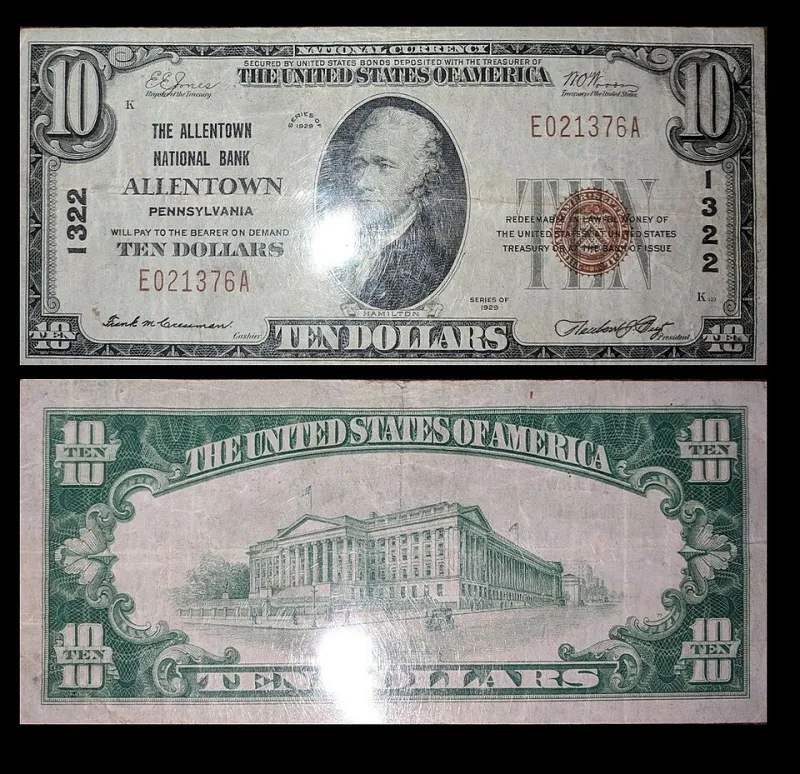
Photo: United States Treasury Department, Public domain, via Wikimedia Commons
Let's get one thing straight before we start: $10 is not a bankroll in any serious sense. Professional players would call it a rounding error. But most American mobile players aren't professionals — they're people who want a little Friday-night entertainment, and the question isn't "how do I turn $10 into $1,000?" It's "how do I make $10 last all weekend without waking up Monday to a drained checking account?"
So we ran the experiment. One writer, one popular sweepstakes-style casino app, ten dollars, 48 hours, and a spreadsheet. Here's the diary.
Friday, 7:12 p.m. — The Deposit Trap
First mistake, made before a single spin: the deposit screen. The app's default options were $19.99, $49.99, and $99.99, with the "best value" badge splashed across the middle tier. The $10 option? Buried at the bottom, unlabeled.
This is standard practice. Deposit ladders are engineered to make the smallest option feel like a bad deal — and honestly, per-coin, it sometimes is. But the whole point of a $10 weekend is that $10 is the maximum loss you've pre-approved. The $49.99 "value" bundle is only a better deal if you were going to spend $50 anyway. You weren't. That's the trap.
Lesson one: decide your number before you open the app, and scroll past the badges to find it.
Friday, 7:30 p.m. — Free Spins, Read the Fine Print
The app offered a free-spin welcome package, which sounds like house money. It is not. The spins were locked to two specific games, capped at $0.10 per spin, and — the important part — winnings from free spins carried a 1x playthrough before they converted to a redeemable balance.
That 1x is actually decent. Many social casinos require far more, or convert free-spin winnings to "promotional credits" that can be played but never redeemed. The rule of thumb we landed on: free spins are only "real" if the winnings reach your cash-equivalent balance without a playthrough multiplier in the double digits. Anything requiring 10x or more is marketing, not money.
The free spins produced $4.20. Which, to be fair, is $4.20 more than nothing.
Saturday, 2 p.m. — The $10 in Action
Here's where the spreadsheet gets interesting. We played low-volatility games at $0.20 per spin, which works out to 50 spins per $10 of real money. Fifty spins at two-second cycles is maybe four minutes of play — unless you slow down.
The single biggest lever on a tiny bankroll isn't game selection. It's tempo. By using the app's autoplay at the slowest setting, taking breaks between sessions, and treating each $2 as its own mini-session with a stop point, the original $10 plus free-spin winnings stretched across four separate sessions on Saturday.
Peak balance: $16.80, around 9 p.m. Saturday. We cashed out the original $10 at that point — a move we'd recommend to anyone. Getting your stake back means the rest of the weekend is played entirely with the house's money, psychologically and literally.
Sunday, 6 p.m. — The Final Tally
The remaining $6.80 survived until Sunday evening and died, as tiny bankrolls do, to a high-volatility game we had no business playing at $0.40 a spin. Boredom is expensive.
Total entertainment cost: $0. Total entertainment delivered: roughly three hours across two days, or about the price of a single movie ticket — except the movie ticket is guaranteed fun and this was, at best, a coin flip.
The Monday Morning Rules
If you take anything from our diary, take these:
- Pre-set your number and deposit exactly that. Ignore the value badges.
- Free spins count only if the playthrough is low. Otherwise they're a demo with extra steps.
- Slow the tempo. Small bets, long sessions, breaks between.
- Pull your stake out when you're up. Play the weekend on winnings.
- When the bankroll dies, the weekend is over. Not "one more deposit." That's the whole trick the app is pulling, and you already know it.
Ten dollars can absolutely buy a weekend of spinning. It just can't buy a second one — unless you let it.